Evolving Out of Eden: Christian Responses to Evolution by Robert M. Price & Edwin A. Suominen
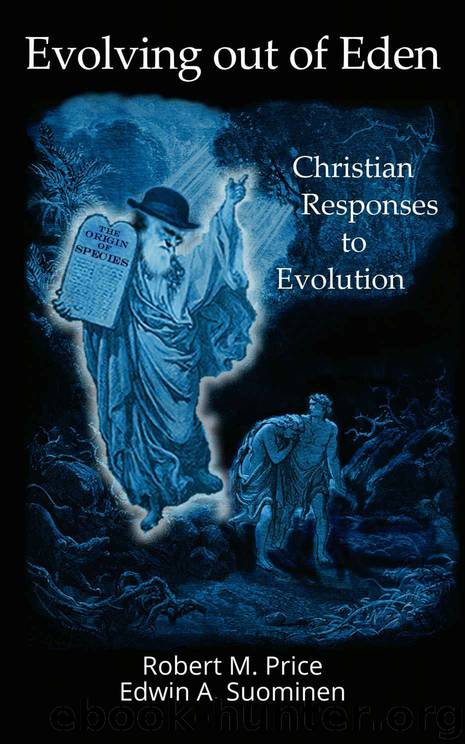
Author:Robert M. Price & Edwin A. Suominen [Price, Robert M. & Suominen, Edwin A.]
Language: eng
Format: epub
Tags: Science, Non-Fiction, Evolution, Christianity, Religion, Biology
ISBN: 9780985136246
Google: wUjimAEACAAJ
Publisher: Tellectual Press
Published: 2013-03-29T04:01:33+00:00
Jesus Christ Superchimp?
We have seen (and boy, have we seen) the difficulties that modern genetics poses for traditional theology’s understanding of Adam and Eve as the parents of the whole human race. Our intent is not to embarrass the ancient texts but, on the contrary, to defend their right to stand as monuments of ancient belief and thought without warping and twisting them in order to make them seem compatible with modern knowledge. In the same way, we must inquire as to the implications of scientific genetics for the genesis of the Second Adam, Jesus Christ. As with the more sophisticated forms of creationism, the conflict of science is not precisely with the Bible but with certain doctrines derived from a selective reading of it, with theology more than the biblical text itself. Will we find such conflicts in the case of the genetic origins of Jesus?
Christian doctrine has historically held that Jesus Christ was miraculously conceived of the Holy Spirit (the third person of the Godhead) in the Virgin Mary, with no contribution from Joseph or any mortal father. The resultant child, Jesus, was already as an infant both God and man. He was a single person (this personhood being derived from God and divine at its core), supporting two full natures, divine and human. He was not a demigod, half human and half divine. He was not God wearing a fleshly scuba suit. He was not even two-thirds human (possessing human body and soul, but no human spirit) yet fully God (the divine Logos substituting for the human spirit). As the Nicene Creed has it, Jesus Christ, God’s Son, was “begotten, not made.”
Theologians have seldom if ever contended that all these careful nuances were explicitly taught upon the biblical page. Had that been so, it should never have taken three centuries for the underlying issues and questions to arise. The credal definitions were hammered out by convocations of ancient bishops and theologians. Their goal was twofold. They wanted to frame a Christology compatible with the various biblical hints as to the nature of Jesus Christ. And they wanted to stay consistent with a doctrine of salvation by divinization (theosis), the infusion of God’s immutable immortality into humans as if by a kind of transfusion from God (as Jesus Christ). Especially for the latter, the savior had to have been fully God, not some mere angel, prophet, or wisdom teacher.
As if all this were not difficult enough, new conundrums arise when we superimpose our understanding of genetics. For we have to ask: What is the nature of the genetic material that God must have caused to appear inside Mary and to unite with her set of chromosomes? Did God create them ex nihilo? If so, does that conflict with the Nicene assertion that the Son was begotten, not made? Presumably that claim refers to the eternal begetting of the Logos, the Father’s eternally present generation of the Word. Was the divine Logos already united with this created set of
Download
This site does not store any files on its server. We only index and link to content provided by other sites. Please contact the content providers to delete copyright contents if any and email us, we'll remove relevant links or contents immediately.
The Lost Art of Listening by Michael P. Nichols(7482)
Why I Am Not A Calvinist by Dr. Peter S. Ruckman(4134)
The Rosicrucians by Christopher McIntosh(3503)
Wicca: a guide for the solitary practitioner by Scott Cunningham(3158)
Signature in the Cell: DNA and the Evidence for Intelligent Design by Stephen C. Meyer(3118)
Real Sex by Lauren F. Winner(3000)
The Holy Spirit by Billy Graham(2933)
To Light a Sacred Flame by Silver RavenWolf(2802)
The End of Faith by Sam Harris(2723)
The Gnostic Gospels by Pagels Elaine(2515)
Waking Up by Sam Harris(2447)
Nine Parts of Desire by Geraldine Brooks(2355)
Jesus by Paul Johnson(2347)
Devil, The by Almond Philip C(2322)
The God delusion by Richard Dawkins(2295)
Heavens on Earth by Michael Shermer(2268)
Kundalini by Gopi Krishna(2168)
Chosen by God by R. C. Sproul(2150)
The Nature of Consciousness by Rupert Spira(2083)
